
What to Look for When Buying a Yurt
A Practical Guide
from the Workshop
Two yurts can look quite similar in photographs and yet be very different in the way they are made. The differences are not always obvious, particularly when you are looking at prices and trying to work out what is included.
We have been making yurts since 2005, and have learnt a great deal from building them, pitching them and seeing how they stand up to years of use. Here are some of the things we would look at when choosing a yurt, whoever makes it.
Start with How You Will Use It
A yurt for occasional summer weekends has different demands from one used every day as a studio, therapy room or home. The site matters too. A sheltered garden in southern Spain is very different from an exposed hillside in Wales.
Before comparing specifications, think about the season, the climate, how often the yurt will be occupied and how much natural light and ventilation you want. A good maker should be interested in those questions, not just the diameter.
Look Closely at the Wooden Frame
The lattice wall, roof poles and crown form the structure of the yurt. Ask what wood is used, how it is selected and how the joints and connections are made.
Different woods have different strengths and characteristics. What matters is not simply the name of the wood, but whether it is appropriate for the component and has been prepared and worked properly.
We use natural chestnut for our wall frames and roof poles. We know the material well, including which pieces to select and which to reject. It has strength and flexibility, and we like the character of the natural wood.
Pay Particular Attention to the Crown
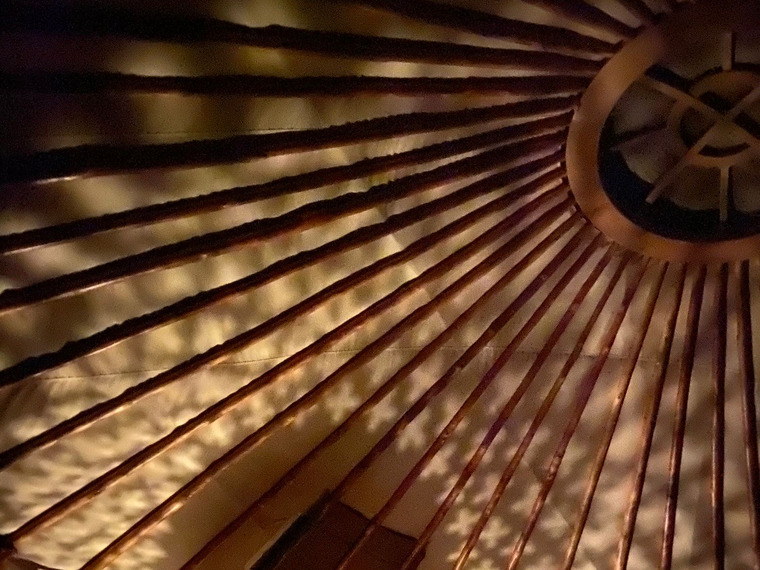
The crown is one of the most important parts of a yurt. It carries the roof poles and helps determine the shape and balance of the roof. It is also the feature your eye is drawn to when you look upwards inside.
Ask what it is made from and how it is constructed. Softer woods can be easier to work, but the crown needs to remain stable over time. The design and quality of the joints matter just as much as the material.
Our own crowns are handcrafted from solid oak, with a distinctive eight-spoke design made from 24 separate pieces. We chose hardwood because of what we learnt about the long-term behaviour of crowns, not simply because it looks beautiful.
Think About the Covers, Not Just the Colour
A cover has to keep the rain out, but there is more to it than being waterproof. The way a yurt manages moisture is important, especially in a damp climate or when it is occupied throughout the winter.
Ask what the outer covering is made from, whether it is breathable, how the layers overlap and how rainwater is shed. An impermeable covering may keep out rain, but if moisture becomes trapped within the structure, condensation can cause problems.
We use durable, proofed polycotton for our outer covers. It combines water resistance with breathability. Our insulated yurts also have a double-canvas roof, providing another layer of protection over the main roof and insulation beneath.
Understand What Insulation Includes
If you want to use a yurt regularly in colder weather, insulation makes a substantial difference. But the word insulated does not tell you everything.
Ask what material is used, where it sits, whether there is an inner liner, how the crown is treated and how the layers fit around doors and windows. The whole system needs to work together.
Our insulated yurts use natural wool felt, a bright fire-retardant inner liner and our double-canvas roof system. Wool felt helps retain warmth in winter and moderates heat in summer. Heating and sensible ventilation are still important.
For a fuller discussion, see How Warm Is an Insulated Yurt in Winter?
Check the Proportions and the Details
Wall height, roof pitch and crown diameter all affect the way a yurt looks and feels. They also influence how the structure works. A well-proportioned yurt has a natural sense of balance that is difficult to judge from a list of specifications alone.
Look closely at photographs of the inside, not only the exterior. How do the roof poles meet the crown and wall? How are the covers fitted around the openings? Are doors and windows designed as part of the structure?
These are often the details that reveal how much thought has gone into the yurt.
Consider the Floor and the Site
A yurt needs a sound, level base that keeps the wood clear of wet ground. For most situations we recommend a simple raised wooden platform, supported on suitable blocks and with ventilation beneath.
The fit between the floor and the yurt is important so that rainwater sheds outside the platform rather than finding its way in. Ask the maker for clear floor-making guidance before you build anything.
Also think about access to the site, prevailing winds, drainage and how you will pitch and maintain the yurt. These are manageable practicalities, but they are worth considering early.
Compare What Is Actually Included
When two quotations are very different, it is worth checking whether they describe the same thing. One price may be for a basic canvas yurt while another includes insulation, an inner liner, a second roof, doors, windows or other fittings.
Ask for a clear written specification. Check the materials, the number and type of openings, delivery, installation arrangements, lead time and what support is available after purchase. It is also worth asking how replacement covers or individual components can be obtained in future.
A lower price is not necessarily poor value, and a higher price is not automatically better quality. The point is to understand what you are paying for and whether it suits the way you intend to use the yurt.
Ask About Experience and Support
Yurts are unusual structures. There is a difference between knowing how to assemble one and knowing how its materials behave after years of sun, rain, wind and everyday use.
Ask how long the maker has been producing yurts, whether they make the components themselves, what guidance is provided for pitching and what happens if you need advice or a replacement part later on.
Good photographs, clear answers and examples of yurts that have been in use for years can tell you a great deal.
A Yurt You Will Be Happy With for Years
Choosing a yurt is about more than finding the right size or the lowest price. It is about finding a structure that feels right, works well on your site and has been made with care.
We have explained more about the decisions behind our own construction methods on The Yurt Workshop Advantage page. You can also explore our insulated yurts or get in touch if you would like to talk through an idea.