
A Family Business
Making Yurts for More Than Twenty Years
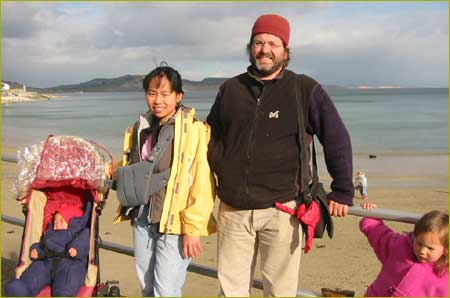
Yurt Workshop grew out of quite a change in our lives. Rob originally trained as a chemist, completing a PhD at Durham University, and later worked in software and ran a small internet business in London. After moving to Andalucia, we became increasingly interested in ecological living and low-impact buildings.
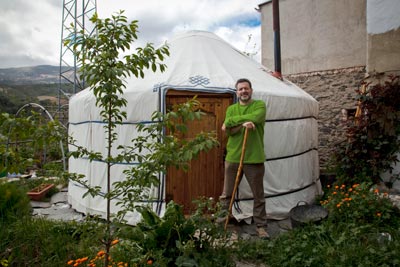
Our interest in yurts began when a friend came back excitedly telling us about staying in one. It wasn’t long before we had a yurt of our own. We loved the whole experience of it, and that first yurt planted the seed for what eventually became Yurt Workshop.
When we decided to start making yurts ourselves, we went to Somerset to study yurt making with Paul King of Woodland Yurts. Yurt Workshop began in 2005.
Rob later travelled to Kyrgyzstan to take part in an international felt symposium and learn more about traditional felt making and the culture surrounding yurts.
More than twenty years later, we are still a small family business, still making the yurts here in our own workshop, and still using and developing them ourselves.
What Matters to Us
First of all, we think a yurt should look right.
The proportions matter: the pitch of the roof, the height of the wall, the crown and the way the whole structure comes together.
It also has to work properly. Over the years we have kept the traditional form and natural materials where they make sense, while changing materials and details where we have found a better way of making the yurt stronger, more weather resistant or easier to live with.
Made in Our Own Workshop
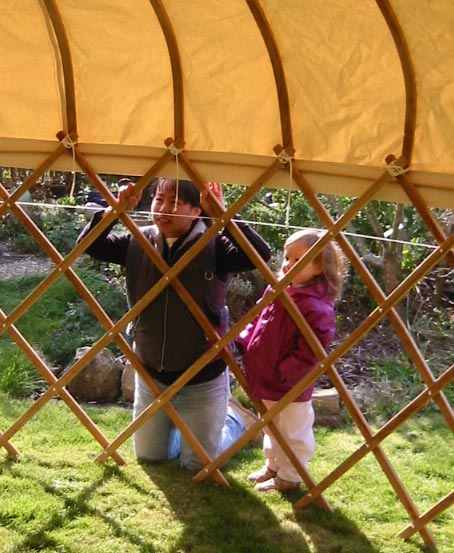
We make the natural chestnut wall frames and roof poles here in the workshop, together with the handcrafted solid oak crowns that have become one of the recognisable features of our yurts.
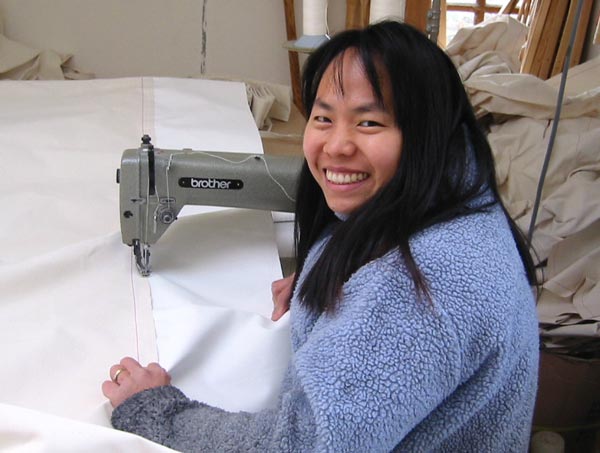
The chestnut is selected, shaped and finished by us, and the covers are cut and made to fit each yurt.
Making the different parts ourselves means we can keep control of the proportions, fit and finish rather than treating the yurt as a collection of standard components.
More Than Twenty Years of Making Yurts
Over the years we have made hundreds of yurts for customers in the UK, France, Belgium, the Netherlands, Italy, Portugal, Germany, Spain and further afield.
That has taught us a great deal. Yurts end up in very different climates and are used in very different ways. Some are homes, some are guest accommodation, some are studios, classrooms, retreats or simply somewhere to escape to.
A lot of the changes we have made over the years have come from seeing how the yurts actually perform once they have been out in the world for a long time.
Our Glass Wall Yurts
We introduced our Glass Wall Yurt in 2013 and have been developing it ever since.
Fitted glass doors, windows and wall panels allow part of the traditional canvas wall to be opened up to light and the view outside, while keeping the character and structure of the yurt.
Glass Wall yurts have become a large part of what we make, and the amount and arrangement of glass can be worked out around each yurt and its setting.
Built for the Climate
Our insulated yurts use 100% natural wool felt and our double-canvas roof system, with an additional outer roof giving another layer of protection over the insulation and roof beneath.
The materials used through the insulated layers also have fire-retardant certification, something that can be particularly important for commercial and public-use projects.
These details have developed gradually through years of making yurts for wet, hot, cold and windy parts of Europe.
Thinking About a Yurt?
You do not need to know exactly which size or specification you want before getting in touch.
Tell me where the yurt will be, what you are thinking about and how you expect to use it. We can work through the options together and, once we have a clear idea of what you need, I can prepare a detailed estimate.